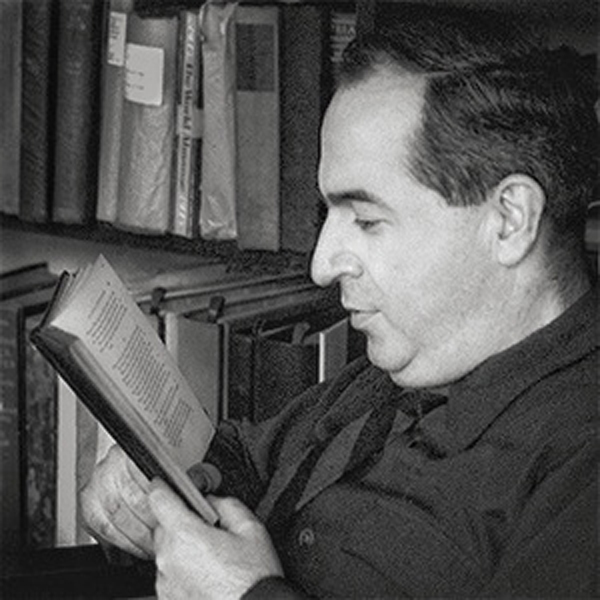
Eli Siegel (1902-1978), great American poet, critic, and founder of the philosophy Aesthetic Realism, is the author of Self and World: An Explanation of Aesthetic Realism; Hot Afternoons Have Been in Montana: Poems; and James and the Children: A Consideration of Henry James’s The Turn of the Screw.
In 1925 his groundbreaking poem “Hot Afternoons Have Been in Montana” won the highly esteemed Nation Poetry Prize and swept America. In 1958 his book of poems with that title was nominated for the National Book Award and he was nominated for the Pulitzer Prize in poetry. For his centenary in 2002, the city where he grew up, Baltimore, Maryland, celebrated Eli Siegel Day, with proclamations by the mayor and governor and a celebration in Druid Hill Park.
Teaching in New York City for four decades, Eli Siegel gave thousands of thrilling lectures and classes on the arts and sciences, including many on the relation of science and art. Based on the principles he taught, the Aesthetic Realism Foundation provides a variety of classes, currently via video conferencing.
The Rightness of Aesthetic Realism: A Periodical
Many of Eli Siegel’s groundbreaking works are published in The Rightness of Aesthetic Realism: A Periodical (TRO), the international periodical he began in 1973. It explains what is happening in the world, and in people—in you. TRO contains immensely valuable and timely essays, poems, and lectures by Mr. Siegel and articles by Aesthetic Realism teachers and students. In every issue there is an editorial commentary by Ellen Reiss, who Mr. Siegel appointed the Aesthetic Realism Chair of Education. With scholarship and humanity, she has continued his work, together with many others.
Receive email alerts for each new issue of The Rightness of Aesthetic Realism: A Periodical, and announcements of events at the Aesthetic Realism Foundation.
Current issues of TRO:
Knowledge and Feeling, as One
(Issue #2177, Oct 2026). How much do we need to know what poetry is and can mean to us? Is poetry some distant thing, or is it crucial for our lives? This latest issue of TRO shows that it’s urgent (and thrilling) to learn what makes for poetry that’s the real thing. Here, in a section of a 1951 talk, we have the big experience of seeing Eli Siegel—prize-winning poet and great philosopher and critic—discuss three of his own poems. He does this so movingly, with clarity and also humor. And I, Aesthetic Realism consultant Jeffrey Carduner, say too: I respect very much how TRO’s editor, Ellen Reiss, expresses her opinion of Mr. Siegel, with exactitude, perspective, and passion. I believe the centuries will agree with her. read
The Technique of Poetry, & Our Lives
(Issue #2176, Sept 2026) The new issue of TRO is about the importance of words—how we see them, how we use them. I (Steven Weiner, a TRO Coordinator) love this sentence in the new issue: “Poetry is a way of having you live more.” I’ve experienced the truth of that so much in my study of Aesthetic Realism. Is authentic poetry, because of its sincerity with words, vital to our happiness and well-being? Yes! —In this TRO you’ll learn too about an immensely meaningful friendship in American literature: that of Eli Siegel and William Carlos Williams.” read

Mind, Poetry, & Is the World a Friend?
(Issue #2175, Aug 2026). We all of us have a mind of our own, precious to us, and we want our mind to work well. What would that mean? And what does it have to do with poetry? The understanding of mind and of poetry in the current issue of TRO is thrilling, new, and definitive. That big aspect of mind, imagination, is explained in a way humanity needs very much. Yes, there are kind riches of knowledge in “Mind, Poetry, & Is the World a Friend?,” the August number. read
Mind and the Two Kinds of Imagination
(Issue #2174, Jul 2026). This TRO makes thrillingly clear something that has eluded people for centuries: what mind is, what its purpose is; also, what makes that aspect of mind, imagination, good and what makes it go wrong. Through the knowledge told of here, people—we—can finally respect ourselves on a steady basis for how our minds work! This TRO can have one begin to understand one’s own imagination and see how it can really work well—not just “cleverly” but deeply, proudly, excitingly, and justly! read
Selected issues from the TRO Archives:
What Opposes Love?
(Issue #150) “The history of the world and the history of literature tell us that love has been opposed by hate and contempt….The play in French literature that stands for the discomfort of love, the unsettlement of passion, is the Phèdre of Racine…” read more

The Greatest Gift: Authentic Criticism
(Issue #820) “We publish here the great essay ‘Art as Criticism,’ by Eli Siegel….Aesthetic Realism shows…that no amount of praise or ‘acceptance’ will ever have us like ourselves. We want authentic criticism, criticism with enough knowledge in it.” read more

What Is Art For?
(Issue #226) “Aesthetic Realism sees the purpose of art as, from the beginning, the liking of the world more…. [Helen] Gardner’s mighty work, Art Through the Ages… tells carefully of Etruscan art, medieval Russian art, and certainly the art of Renaissance Italy; tells of the art of the American Indian and of United States art.” read more

The Shakespearean Awareness
(Issue #156) “Every dramatist has to be aware of the three great emotions which, when used not in behalf of a more just world but in behalf of a superior self, can do such harm….Shakespeare says much of fear, anger, contempt. Some of the highest points in the world’s literature have Shakespeare’s awareness of these three emotions.” read more

The Two Pleasures
(Issue #162) “One thing that is clear in the history of man is that he has had pleasure of two kinds. Man has had pleasure from seeing a sunset; from Handel’s Messiah; from seeing courage in someone; from a great rhythm in words. He has also had pleasure from making everything he can meaningless….Man, then, praises; he also diminishes.” read more

Aesthetic Realism Is Education
(Issue #12) “Aesthetic Realism believes that a person who doesn’t like the world on an honest basis is not educated. The purpose of all education is, as Aesthetic Realism sees it, to find sense in the world; also honestly to hope to find sense in the world when that finding, as it often is, is difficult.” read more

Knowing Oneself
(Issue #200) “Geoffrey Chaucer, the first unquestionably eminent English poet, said about six hundred years ago in his ‘The Monk’s Tale,’ this: ‘Ful wys is he that kan hymselven knowe!’ Well, even now, Chaucer is not agreed with, though certainly people often act as if they felt it was wise to know oneself.” read more

The Fight
(Issue #151) “The greatest fight man is concerned with, is the fight between respect for reality and contempt for reality that has taken place in all minds of the past and is taking place now. There are three places in literature which make the fight between respect and contempt clearer….Sonnet 66 of Shakespeare; Baudelaire’s ‘O Mort, vieux capitaine’; and Shelley’s ‘Ode to the West Wind.’ ” read more

Our Dear Minds
(Issue #239) “Perhaps the person who was most successful in philosophic history was John Locke, 1632-1704…. Locke meant a good deal to the plain, money-getting person; and still means a good deal….Today, I deal chiefly with John Locke; but I hope to show that all the philosophers…present a world we can see as usable for our lives, deeply on our side.” read more
